Press Release · Seoul National University of Science and Technology
SEOULTECH Researchers Develop Liver-on-a-Chip Platform for Practical Chemical Toxicity Testing
Distributed by Love AI Tools · Originally issued via PR Newswire
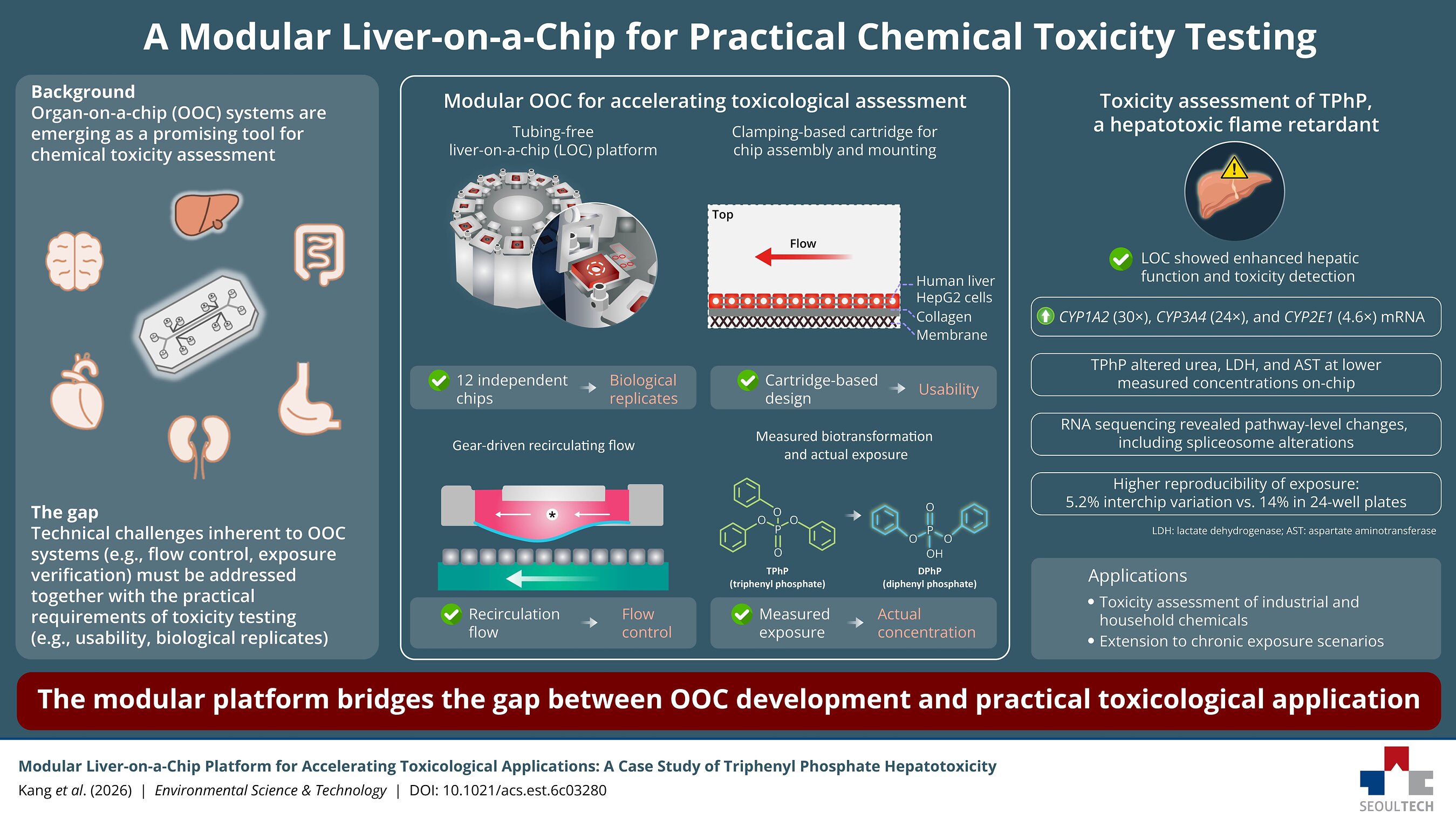
Researchers develop a practical organ-on-a-chip platform for environmental chemical assessment that can replace resource-intensive animal testing
SEOUL, South Korea, Nov. 20, 2026 — Among the thousands of chemicals used in daily life, toxicity information is available for only a small fraction. Much of this information comes from high-dose animal studies, which are costly, time-consuming, and limited by species differences.
Organ-on-a-chip (OOC) systems use microfluidics to mimic human tissue and organ physiology, offering a more human-relevant approach to toxicity testing. However, their application to toxicological assessment remains challenging due to usability, flow control, and biological replication. Complex tubing in flow-based OOC systems can further complicate their implementation.
To address these challenges, a research team involving Professor Ki-Tae Kim and PhD candidate Jiyun Kang from the Department of Environmental Engineering at Seoul National University of Science and Technology (SeoulTech), has now developed a modular liver-on-a-chip (LOC) platform, designed specifically for environmental toxicological assessment. "The use of organ-on-a-chip platforms for environmental chemical assessment has advanced slowly, since testing many chemicals at multiple concentrations puts different demands on the system," explains Prof. Kim. "Our study offers insights into how these issues can be resolved and where these systems could be useful." Their study was made available online on August 27, 2026 and published in Volume 60, Issue 36 of Environmental Science & Technology on September 15, 2026.
The proposed LOC platform accommodates 12 cartridge-based chips in parallel. It features a tubing free design with each chip consisting of an easy-to-use clamping-based sealing mechanism. A single LOC chip consists of human liver HepG2 cultures and features independent unidirectional recirculating flow, where the flow rate and shear stress are determined by gear-based peristaltic pumping. Unlike static plate-based cultures, this recirculating flow continuously exposes cells to the circulating medium and enables controlled, reproducible chemical exposure, better reflecting biological conditions.
In tests, the LOC platform demonstrated stronger hepatic function compared to static plate-cultures, with markedly higher expression of CYP1A2, CYP3A4, and CYP2E1 mRNA. The researchers used the LOC platform for evaluating the hepatotoxicity of triphenyl phosphate (TPhP), which is a common flame retardant used in household items, with known links to liver toxicity.
During experiments, the cartridge modules demonstrated high reproducibility and uniform chemical distribution. In response to TPhP exposure, the platform showed changes in levels of hepatic phenotypic markers, including urea, lactate dehydrogenase (LDH), and aspartate aminotransferase (AST). Notably, these altered responses were observed at lower measured concentrations compared to plate-based cultures. Furthermore, RNA sequencing of the exposed HepG2 cells revealed changes in biological pathways associated with TPhP-induced hepatotoxicity, including spliceosome and inflammatory signaling pathways. Overall, the experiments showed that the platform provides biological replicates without pooling, stable flow control and direct measurement of exposure profiles.
"Our platform can support human toxicity assessment based on real cell exposure, enabling next generation risk assessment," remarks Prof. Kim. "Importantly, we measured the chemical concentrations in the system and followed their kinetics during exposure. This means that the toxicity observed can be tied to the concentration the cells actually experienced."
This work highlights how some practical challenges in applying OOCs may be addressed. The researchers hope that continued improvements will make the technology increasingly suitable for assessing or predicting chronic effects and other long-term toxicological outcomes.
Reference
Title of original paper: Modular Liver-on-a-Chip Platform for Accelerating Toxicological Applications: A Case Study of Triphenyl Phosphate Hepatotoxicity
Journal: Environmental Science & Technology
DOI: https://doi.org/10.1021/acs.est.6c03280
Media Contact:
Seo-Hee Yoon
82-2 - 970 - 9166
[email protected]
SOURCE Seoul National University of Science and Technology
About the institute Seoul National University of Science and Technology (SEOULTECH)
Website: https://en.seoultech.ac.kr/